

Hints to Protect Your Plants during a Hard Freeze
Time is now to prepare for the massive, short and sharp arctic outbreak forecasted for us this weekend. Expect temps to be into the teens and single digits in some area with icing conditions. What makes it worse for us gardeners are that that our landscape plants up until now have not gone into dormancy. This makes them more susceptible to freeze damage. Now is your last chance to take extra precautions. (In fact, I even have Turk’s Cap and Lantana still in flower now!) Summer flowering landscape plants are normally pruned by this time; however, I like to assess how much winter damage there is before I prune.
Anyway, you have several choices to avoid freeze-damage to your plants.
The basic protection will be by covering or mounding with mulch or pine needles (and removing it shortly after the cold snap. Small plants can be covered with mulch with cardboard boxes and buckets.
Watering the soil around the plants allows heat to be released around your plants.
Standard plastic is better than nothing, but you need to use hoop stakes to keep the plants away from the plastic which by itself has no insulation value. Plants will freeze against it. [As an aside I have a friend who had saved 3 – 6’ to 8’ tall Red Banana plants in the back yard, using only 4 mil plastic, a bunch of tape, and a single chandelier bulb at the base of each of them to save them from the major freezes we had over the past three years in Leander. No bananas yet, but they are over ten feet tall now and quite a conversation piece!]. I digress.
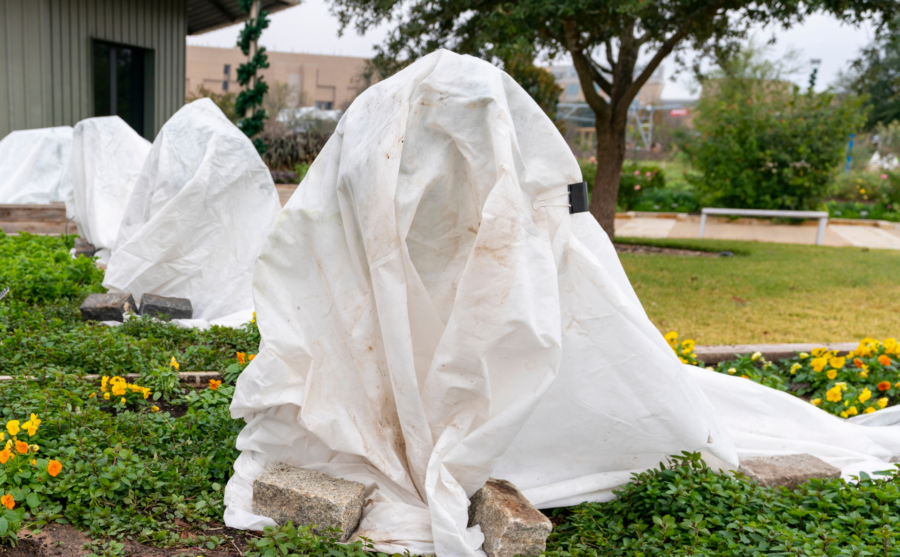
The best freeze protection will be using frost cloth or frost blankets. Frost blankets are not like the heavy blankets or fabrics that get wet and may cause more damage by crushing the plants and still allowing the cold frosty air to penetrate. A double whammy!
Frost blankets are a specialty product sold at most garden centers, which are reusable, very light, gauze-like polypropylene material that allows sunlight, air, and moisture to pass through but still traps heat around the plants. The better choice of these would be the white material polypro rather than dark colored materials that can heat up too quickly afterwards. Best results are achieved using these blankets with hoops to loosely suspend the material over the plants. Heat radiating from the soil is trapped by the frost cloth. Do not wrap the plants tightly and expose the lower stems as this does not provide much warmth around the plant. Maintain the frost covers until it warms up again and observe for freeze damages that can be pruned off later.
Keep warm Gardeners! This is going to be a wild one….
For more information check out this Texas A&M AgriLife bulletin. Protecting Landscapes and Horticultural Crops from Frosts and Freezes
If you have any questions on how to care for your plantings after the freeze, contact our friendly, experienced HelpDesk Master Gardener Staff in Georgetown at 512-943-3300 or email us at Williamsonhelpdesk.com.
Cheers…
Gary Pastushok, Williamson County AgriLife Extension Agent – Horticulture
SIX POINTS FOR PROTECTING YOUR PLANTS DURING THE FREEZE!
- Mulch or cover over your small plants, pine needles are the best!
- Water the soil around your plants within a day of the freeze, which releases heat and warms your plants.
- The best protective covers are frost cloth/blankets – white, reusable, lightweight polypropylene material which retains heat and is breathable fabric.
- Do not use normal fabric sheets, or blankets. These are heavy, break the plants and have no insulation value (like putting a jacket on a snowman, it won’t melt!)
- Avoid using plastic sheets. If no alternative, use hoops or stakes to suspend the plastic away from the plants.
- Once the freeze is over, prune off the dead plant parts.

Gary Pastushok
County Extension Agent – Horticulture
Williamson County AgriLife Extension Office
Georgetown, Texas 78626
512-943-3300
https://williamson.agrilife.org
Disclaimer: References to products or treatments are for educational purposes only and do not imply endorsement by the Texas A&M AgriLife Extension Service or constitute medical advice.
Share This Story, Choose Your Platform!