

Gnasty Fungus Gnats & Soggy Soils
Have you been bothered by annoying tiny “flies” buzzing around your face in your home or office?
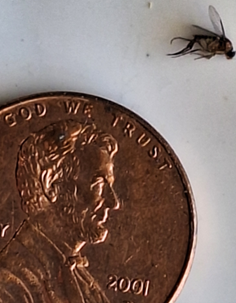
A “large” fungus gnat compared to a penny
Are you seeing small flies running around on the soil in your house plants, or maybe emerging from the sink drains or water saucers, and finding dead ones piling up on your windowsills? Well, these are most likely one of the fungus gnat species. These are tiny adult flies about 1/8th inch in size, and harmless to people. Some species do feed on plant roots and organic matter and if in high enough numbers, they may stunt the growth of young seedlings. You will likely find these little presents in some of the holiday plants that you received, or in an infested potting soil mix. Heavy watering or overwatering contributes to attracting the gnats. This is why you commonly find them in the peat soil of poinsettia plants over the Christmas holidays. Poinsettias are usually potted in a very rich and light peat soil media that attracts house gnats, and especially when the pots are nicely wrapped in colorful waterproof foil that retains moisture. Watering your plants by soaking the pots in a tub is another draw. Porch lights also attract fungus gnats that will gain access to your house when you open the door or windows.
The bottom line is that fungus gnats thrive in soggy organic soils. The eggs are laid in soggy organic soil mixes. Each female gnat can lay up to 200 eggs that hatch in about 3-4 days. The life cycle is about a month, so large infestations can readily build up. I am embarrassed to say that we had a large infestation showing up in our offices over the holiday period and have been battling them ever since.
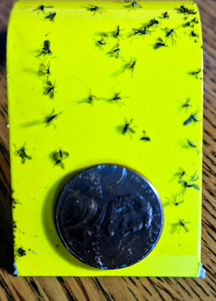
A yellow sticky trap card capturing adult gnats
Controlling gnats is another matter, as the infestation is composed of eggs, larvae, pupae and adults. Not all methods control all the life stages of the fungus gnat. Fungus gnats are highly attracted to thin slices or cubes of fresh potatoes stuck into the soil. These are magnets for gnats. Leave these in the pot and replace each 2-3 days and discard them (in a closed bag of course). An effective biological larvicide called Bacillus thuringiensis israelensis (Bti) (Gnatrol®) is a commercial soil drench. (Note that there are different kinds of Bacillus, such as Bacillus thurengensis kirstaki which is the strain of bacteria used for mosquito larvae control but are ineffective on the fungus gnat.) Many folks also swear on using bright yellow sticky traps mounted low in the plant pot that can capture females. Unfortunately, these sticky traps look impressive, however they are only partially effective. One can also utilize the low toxicity pyrethrin (-thrins) insecticides which were adopted after the natural pyrethrum from the chrysanthemum flower. The best strategy, however, is to control the larvae.
Adopt an Integrated Pest Management (IPM) Strategy to put a check on gnats. This involves using a combination of cutting back on the watering, allowing the top of the soil to dry, removing the top inch or two of soil and replacing with fresh sterile soil, and adding fresh potato slices that are changed out each couple of days will significantly reduce your problem with the gnats.

Gary Pastushok
County Extension Agent – Horticulture
Williamson County AgriLife Extension Office
Georgetown, Texas 78626
512-943-3300
https://williamson.agrilife.org
Disclaimer: References to products or treatments are for educational purposes only and do not imply endorsement by the Texas A&M AgriLife Extension Service or constitute medical advice.
Share This Story, Choose Your Platform!