

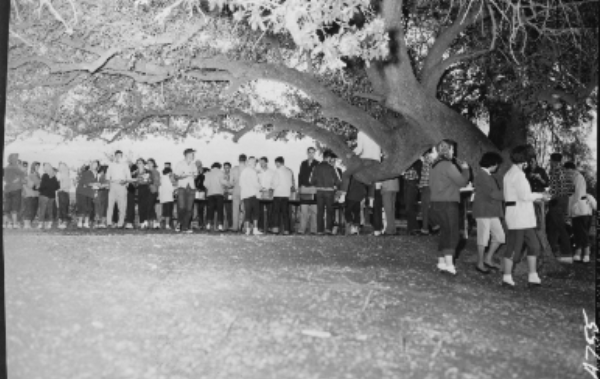
The famous majestic live oak Story Tree is located on the Southwestern University campus in Georgetown. This tree has partially succumbed to the effects of its age, pathogenic fungi, bacterial infections, and who knows what over its 100 years of life. The photos show the Story Tree in the black and white photo from the early 1950s, to today.
03 story tree past
Students having a picnic underneath the Story Tree Source: SU Special Collections & Archives Creator: unknown Date: circa 1950s-1960s
During November a large 3’ diameter branch broke off from the main trunk. Thankfully no one was injured during the limb breakage. Distorted woody blister-like growths on the tree are called conks. Conks are formed by common pathogenic bacteria called Agrobacterium tumefaciens. Interestingly, this bacterium was discovered to have the natural ability to transfer genetic traits from one organism to another and have been widely used to develop GMO crops since the early 1980s.
The famous majestic live oak Story Tree is located on the Southwestern University campus in Georgetown. This tree has partially succumbed to the effects of its age, pathogenic fungi, bacterial infections, and who knows what over its 100 years of life. The photos show the Story Tree in the black and white photo from the early 1950s, to today. During November a large 3’ diameter branch broke off from the main trunk. Thankfully no one was injured during the limb breakage. Distorted woody blister-like growths on the tree are called conks. Conks are formed by common pathogenic bacteria called Agrobacterium tumefaciens. Interestingly, this bacterium was discovered to have the natural ability to transfer genetic traits from one organism to another and have been widely used to develop GMO crops since the early 1980s.
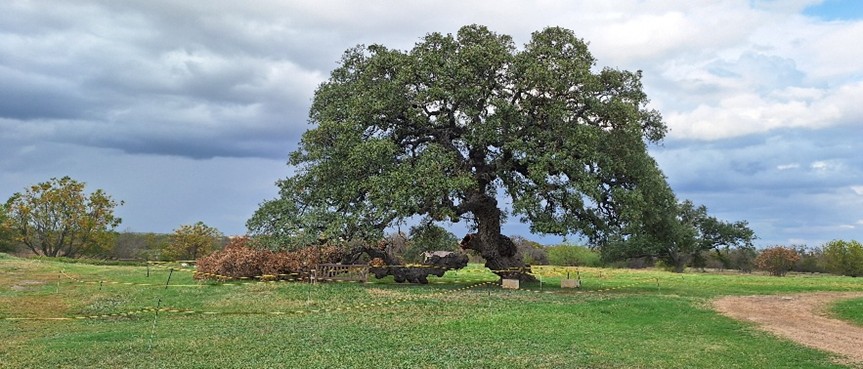
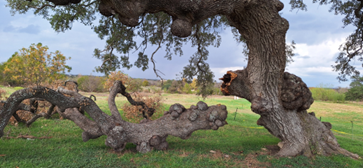
Over many years, questionable management practices were implemented on the Story Tree. Cracks and holes in the trunk and main limbs were filled with concrete, in an ill-advised attempt to strengthen it. These acts likely encourage wood rotting organisms’ activity within the tree. Trees are naturally adapted to heal wounds by themselves. Providing them with the proper fertility and moisture is all they really require in most cases.
We were invited on a fact-finding mission to assess the damage to this historical treasure. Dr. Stephanie Adams, Statewide Arborist for AgriLife Extension (TAMU), representatives of the Texas Parks and Wildlife Service (TPWD) and Southwestern University Environmental Studies Department each joined forces to develop a management plan for the injured tree. Investigations involved addressing concerns for public safety, determining the current and future state of health of this glorious specimen tree and proposing a course of action regarding any remedial activities.
Unfortunately for the Story Tree, the conk growths on the truck and limbs are a sign of internal wood decay. The photos show how much these growths have developed from the 1950s to now. How advanced this decay is unknown, however both brown and white fungal rots were identified. More detailed investigations will be necessary to determine the extent of decay. Trained arborists can incorporate sophisticated techniques such as sonar to map out the internal structure of the tree; or use an age-old proven technique by tapping the trunk and limbs with a rubber mallet while listening for the tone to assess the integrity of the trunk (similar to what a doctor would do to you when using a stethoscope!).
At this point public safety is the first concern. Decisions regarding installing substantial bracing systems for the limbs and/or main trunk may be needed, fencing of the entire area around the tree is a possibility, or removal of the tree entirely. All of these are expensive. If the tree cannot be saved, it is certainly possible to produce clones of the Story Tree by collecting samples, which can be distributed and grown elsewhere and maintained for perpetuity.
We will update our readers on the findings and the future of the Story Tree. Heritage Trees elsewhere in the USA have been successfully saved and cloned using various combinations of these techniques. We’ll see what happens. The Story Tree can live on!
Photo 1, Placing Memory, Story Tree. Whose place is it? Teddy Hoffman ’24. https://placingmemory.southwestern.edu/files/show/53

Gary Pastushok
County Extension Agent – Horticulture
Williamson County AgriLife Extension Office
Georgetown, Texas 78626
512-943-3300
https://williamson.agrilife.org
Disclaimer: References to products or treatments are for educational purposes only and do not imply endorsement by the Texas A&M AgriLife Extension Service or constitute medical advice.
Share This Story, Choose Your Platform!